Interview (Part 5): Spencer Harvey and Lloyd Harvey (2016 Nicholl Winners)
My conversation with the brother and sister writing duo from Australia.

My conversation with the brother and sister writing duo from Australia.
Spencer and Lloyd Harvey wrote the original screenplay “Photo Booth” which won a 2016 Nicholl Fellowship in Screenwriting. Recently I had the opportunity to chat with the pair about their background as writers and filmmaker, and their award-winning screenplay.
Today in Part 5, Spencer and Lloyd talk about their Nicholl Fellowship experience:
Scott: In the Nicholl Ceremony, you mentioned a writer’s group. Are you participants of a writer’s group?
Lloyd: We do have a writer’s group. We were on hiatus for a little bit, particularly while we were away, but we just started up again two weeks ago, which has been really, really nice. We have a group of actors, playwrights, screenwriters, lots of people from different writing mediums and it’s open to drop ins. It’s a really nice safe space where we can show fresh, timid pages.
Spencer: Show unfinished work without judgment, with everyone understanding that it is not finished.
Lloyd: We wrote the whole first draft of Photo Booth within our writer’s group. We had 20 pages a week to present, then we’d go away, tweak, take it back, and bring the next 20. That really helped us meet our personal goal to get the script done in a certain amount of time.
Scott: That structure, that accountability, there is nothing that beats it. Then you submit it to the Nicholl. What happens after that?
Spencer: The first time or the most recent time?
Scott: There’s more than one time?
Spencer: We took our very first draft to the Nicholl.
Lloyd: With a little bit of courage.
Spencer: Which, if we read back…
Lloyd: It wasn’t so bad. It just wasn’t as tight and specific as this draft. It did OK. It got into the semifinals, and got some good feedback from the reader’s comments, which we really appreciated. It helped us make the next draft stronger. Then we submitted it for 2016…
Spencer: We were very ready this time.
Lloyd: The script was ready. We were also not expecting anything at that stage, knowing that any fellowship like this is a very subjective process, even though the Nicholl as a competition is exemplary in the way that it safeguards against bias, but reading someone’s writing is always going to be a human experience. You don’t know what reader you’re going to get and that’s just a part of it.
We were very fortunate that we had a lot of support behind Photo Booth this year, and it made a really big difference to us.
Scott: I think you were on location somewhere, Lloyd, and you were in your car with your parents, Spencer, and some sort of Skype calls. What happened? How did you find out?
Lloyd: Skype. Yes, we weren’t together, we weren’t even in the same country. I was in New Zealand. We were both heading over there for our Grandma’s 90th birthday.
I had gotten there a little bit earlier and Spencer, along with our parents, were on their way to the airport. It made sense for me to be in front of the computer to take the call.
It was very nerve‑wracking, particularly to wake up early and sit there in front of my computer just waiting. Spencer was on the other side of it, watching it live‑streamed on Facebook, so it was completely out of her control too. [laughs]
Scott: Sort of a metaphor for a screenwriter’s life.
[laughter]
Scott: The experience in L.A.?
Lloyd: It was fantastic.
Spencer: We’ve been visiting for the last five years for different reasons, with different projects. We’ve had no representation, very little help apart from a few special friends who have always championed us, and who would helped us get things into a few hands here and there. But this was a completely new experience.
Lloyd: It was an L.A. we had never seen before.
Spencer: Yes. Suddenly, people were calling us. Suddenly, we had choices. People were taking the time with us to talk about what we were looking to do with our career. We had help.
Lloyd: We had representatives. We had people who wanted to read it and potentially make it. It started some amazing and life‑changing conversations for us that we did not expect to happen at the end of 2016 at all.
Scott: You signed with UTA and the Gotham Group?
Lloyd: We did, yes.
Scott: What is the status on the script?
Spencer: At this stage, I don’t know how much we are allowed to announce officially, but we have a producer who is optioning it at the moment. We should be going into the next stage with her in January.
Scott: Great to hear. Well, very exciting. Again, congratulations on that. Thanks for walking us through your script. I hope people can find a copy of it, because it’s a terrific read. Let’s jump to craft questions here starting with this: How do you come up with story ideas?
Lloyd: We do a lot of walking. Being the two of us, we can talk a lot, which I know is a real blessing in having a writing partner, having someone on the other side to answer your internal questions and validate your ideas.
Spencer: There are lots of different types of thinkers out there. I particularly am a talker/thinker. When I talk, I think better. Sometimes, at the beginning of a sentence, I have no ideas where I’m going with it, and by the end, I’ve figured it out. I like to jump in, I don’t necessarily go into a sentence with clarity. I think talking really, really helps me in particular.
Scott: You land on an idea, and now you’re going to do some prep work on it. What types of things do you do in terms of story prep?
Spencer: We do a lot of visual boards.
Lloyd: We also work with mood reels, particularly as we are drafting, to really get a sense of how the story sounds and how the story feels.
Spencer: Tone is so important to us. If you can make sure you have something, a peg to pop in the dirt there to say, “This is my tone,” then as you naturally veer away from it at certain times, you can go back to that peg, whether it be the mood reel or a look-book. You can go, “That’s the tone,” and remove things that don’t fit.
Scott: How do you go about developing your characters, getting to know them so they reveal themselves?
Spencer: Talking, taking, talking. And these visual representations. Collages. Collections of photographs, paintings, even music, especially music.
Scott: Seeing is believing. You visualize them and all of a sudden, you start to hear their voices come alive?
Spencer: Exactly.
Lloyd: That’s a big help for us.
Spencer: Like the painting of the woman who inspired Eileen. We could hear her voice speaking out of the painting.
Scott: Do you subscribe to the practice of going to outline or no?
Lloyd: Not exactly, not always.
Spencer: We have quite broad outlines, generally.
Lloyd: We definitely don’t start typing until we really know where it’s going to go, at least a good chunk.
Spencer: I feel like having a beginning and an end really helps. Then you figure out a way to get there. [laughs] Sometimes, you have markers along the way. “Act One needs to shift on this point, the midpoint around here, Act Three around here.”
Lloyd: That being said, we’ve just been working on a pilot where we used cards for the first time. Doing scene cards for every scene, committing to that practice to see how we would go with it, and we enjoyed it.
Spencer: Yeah. I have no idea what it would be like for a feature — that has to conclude, but for a pilot, it was nice.
Scott: It was a one‑hour drama?
Lloyd: Yeah, one hour drama.
Scott: So you use note cards to break your story?
Lloyd: We have now.
Spencer: It was helpful, when you’re sitting down and doing the grunt work of writing out the guts of a scene, to not have to wonder what’s coming next. You already have an idea of that, so you can move straight into it.
Scott: Speaking of scenes, what do you think about when you’re writing a scene? What are your goals?
Spencer: For something to happen.
[laughter]
Lloyd: And hopefully something unexpected. [laughs]
Spencer: In a way that’s interesting. When you’re writing a scene, you need to know what you are trying to achieve. And you ask yourself, “What is the most interesting way that I could achieve that?”
Tomorrow in Part 6, Spencer and Lloyd share some insights into the writing craft and advice to aspiring screenwriters.
For Part 1, go here.
Part 2, here.
Part 3, here.
Part 4, here.
Spencer and Lloyd are repped by UTA and The Gotham Group.
Twitter: @SpencerandLloyd.
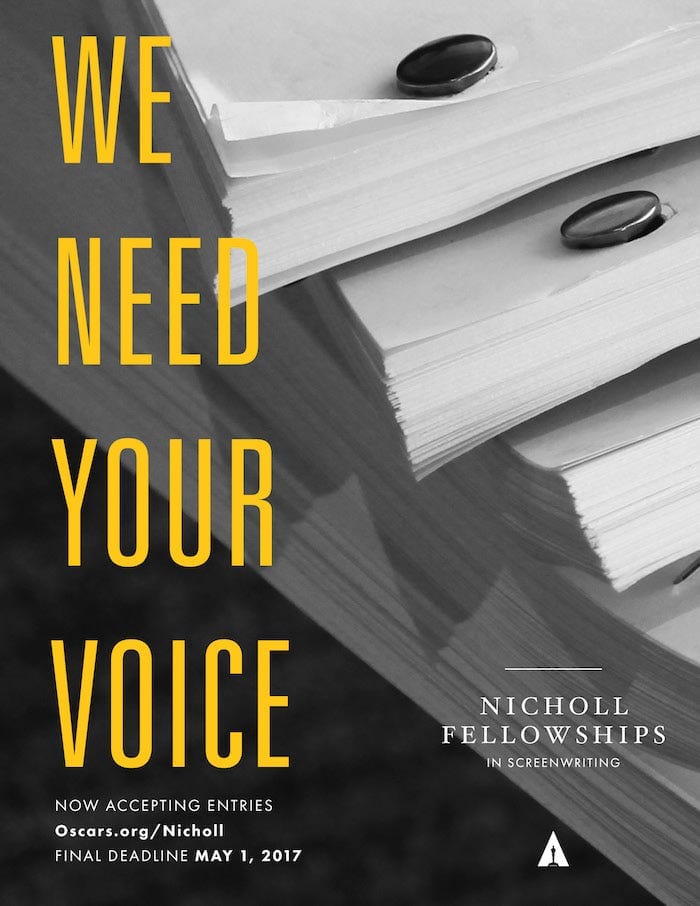
The submission deadlines for the 2017 Nicholl Fellowships in Screenwriting Competition are:
Early Deadline: March 7 ($45 entry fee)
Regular Deadline: April 10 ($60 entry fee)
Final Deadline: May 1 ($85 entry fee)
To get started, visit Oscars.org/Nicholl.