Interview (Part 4): Jon Spaihts
A 6 part series featuring one of Hollywood’s most sought after screenwriters.
A 6 part series featuring one of Hollywood’s most sought after screenwriters.
I have been a fan of Jon Spaihts and his writing for years, so I was excited to have the opportunity recently to spend an hour talking with him about his career, his movies, and the screenwriting craft. His movie credits include Prometheus, Doctor Strange, and his latest Passengers, along with the upcoming films Van Helsing and The Mummy among many others.
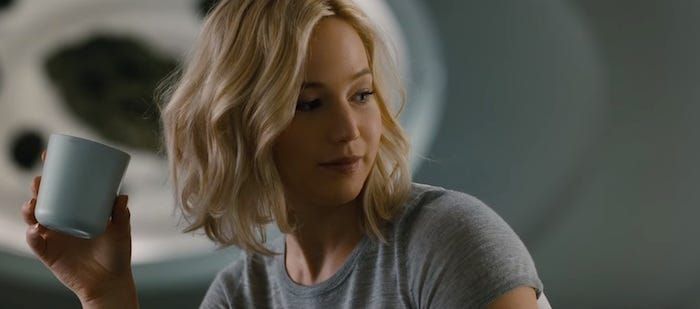
Today in Part 4, Jon shares his thoughts on the Aurora character, played by Jennifer Lawrence, and the “ethical dilemma” at the center of the plot:
Scott: Let’s talk about Aurora, played by Jennifer Lawrence. She’s awakened early as well. Now it’s Jim and Aurora among the living there. How would you describe her and how did you go about developing her as a character?
Jon: She was born, in part, as Jim’s opposite. I needed someone who my humble handyman would see as an ideal woman, but who would, in many ways, prove to be his cultural opposite, his opposite in economic class, and a complete handful when he finally does meet her. She needs to be far more than he bargained for.
It was certainly morally imperative to me that she be at least as strong and forceful a character as he was. She needed to be at least his equal, if not his better.
Scott: She’s a writer.
Jon: That’s right. She has undertaken the emigration from Earth to a colony world for a more high‑minded reason than most. She’s not just looking for a fresh start or a new career, or some land to call her own. She’s looking to document the grand drama of humanity’s expansion to the stars.
She’s going as a chronicler with the startling intention not to stay in the colonies, but to return to Earth, even though that means losing time to star flight not once but twice, and arriving back on her planet of origin, having lost two‑and‑a‑half centuries to hibernation.
Scott: The arc of their relationship has traditional elements. Boy finds girl. Boy gets girl. Girl rejects boy. Will they get back together or not? Quite relateable.
Even the characterizations themselves ‑‑ the mismatched couple you often see in a romantic comedy, but you’ve got this really fascinating thing going on because of a choice that Jim has made, and that it’s set in this spaceship and they’re passengers there.
Jon: Yeah, there’s a giant ethical quandary at the heart of their relationship and at the heart of the film. It really is the subject of the film. On the one hand it’s fantastical in its nature. It’s a thing that can only happen on a long‑haul starship with a hibernation system. In that way it’s not a problem any of us is likely to have.
But, the questions raised fundamentally by the sci‑fi dilemma in the middle of the movie are actually questions that all of us are likely to encounter at one time and another in our lives. Most of us will have to grapple with the power of a secret hidden inside a relationship; with the burden of guilt or shame for something we’ve done wrong.
We’ll have to ask ourselves how much we’re capable of forgiving, or how much we’re willing to give up for love. We will all have to inevitably make peace with the life we were hoping to live, and find a way to be present and live the life that we were given. Which is maybe the secret to grace in human life wherever you may be.
As much as we will never be in Jim or Aurora’s shoes, I think the questions they’re wrestling with are universal questions, and deeply relateable ones.
Scott: What you just said there helps me understand the evolution of the ending, which I want to talk about in just a bit. Let’s talk about Gus. He’s a third passenger who wakes up early and he’s just a great, colorful character. How would you describe him and how did he come into being?
Jon: There are times when you need a fracture, when the best way for a story to leap forward is for something to break the paradigm of the story to that point. Gus is such a fracture. He, arriving on the scene, disrupts the solitude that these two have been locked in.
He’s also the harbinger of a larger disruption, which is his cause and the shadow that accompanies him into the story. The arrival of Gus introduces solutions to old problems, but also introduces new, larger problems, which is always a great thing to have happen in a story ‑‑ to have the axis of crisis pivot.
Scott: Gus has one of the most compelling sides of dialogue in the script. He says, “Space is a funny thing to love. When you’re young the stars are always out of reach. Then you get on a spaceship and get up there, but you’re still looking out through a wall of glass. So you put on a spacesuit and go outside, but you’re still wearing gloves, still looking through glass at something you can’t ever touch. Hard way to fall in love.” What do you think about when you hear those words?
Jon: I love that speech. It says so much about the romance of Gus’s life as a spacer, because he’s not a passenger; he’s a crewman on that ship. Where the passengers debark at the end of each voyage to carry on their lives on a new world, he stays in orbit, retrofits the ship, and heads back the other way, and his life advances by leaps of centuries. He is forever traveling.
His little monologue there about his romance with the notion of space itself, with the infinite, with the starscape, the thing you can never quite reach, the illusory goal. It also, of course, parallels Jim’s experience of falling in love with the initially impossibly remote Aurora. It has resonances inside the movie that ripple back and forth.
The tough bullet about that speech, which I love so dearly, is that, like a handful of other key scenes, it did not make the final cut.
Scott: Oh no. Did not make the final cut. Director’s cut, maybe, eh?
Jon: I’m hoping.
Scott: That’s funny. I’ve talked with writers several times where I read these quotes and they go, “Yeah, we love that quote. It got cut.”
Jon: “Love that one. Didn’t make it.”
Scott: Let’s consider another side of dialogue, see if this one made it. This is Aurora in voice-over where she says, “We’re all passengers. Like seeds, we carry what we need. The wind drives us where it will.” Is that in the movie?
Jon: A modification of that line is in the movie. Yes.
Scott: You had that meeting and the 45‑minute discussion way back when that you got everything set, including the title ‑‑ Passengers. Is it fair to say that we’re looking at this story as a metaphor in a way, or a person could access it that we are passengers here on a spaceship known as Earth?
We’re floating along in our lives, but at any given moment the proverbial, metaphorical comet or physical comet could hit?
Jon: For me the title means not just literally the people sleeping on this starship, but in a larger sense, every one of us who has planned out a life and hopes to move forward and realize a dream, and who will, in that, invariably find that fate carries us at times in unexpected directions. That some of the most important movements in our lives will be accidents, or happenstance. That we will have to find a way to make peace with the direction we have ultimately been carried in. How we are not necessarily captains of our fates as we have been taught to believe, but in fact, ultimately, passengers; and that circumstances will carry us where they will.
Grace in living may mean learning how to accept that and be present in that.
Tomorrow in Part 5, Jon reflects on the 10 year odyssey of Passengers from script to screen and answers some craft questions.
For Part 1 of the interview, go here.
Part 2, here.
Part 3, here.
Passengers, which stars Jennifer Lawrence and Chris Pratt, opens this week in North America and theaters around the world.
Visit the movie’s website here.
For more background on the movie’s decade long odyssey from script to screen, check out this Hollywood Reporter article: ‘Passengers’: The Long, Strange Trip to the Big Screen. And this Indiewire article: ‘Passengers’: Why It Took a Decade to Launch a Black List Darling.
And this: The Science Of ‘Passengers’ According To Screenwriter Jon Spaihts.
Jon is repped by CAA and Circle of Confusion.
Twitter: @jonspaihts.