Interview (Part 6): Spencer Harvey and Lloyd Harvey (2016 Nicholl Winners)
My conversation with the brother and sister writing duo from Australia.
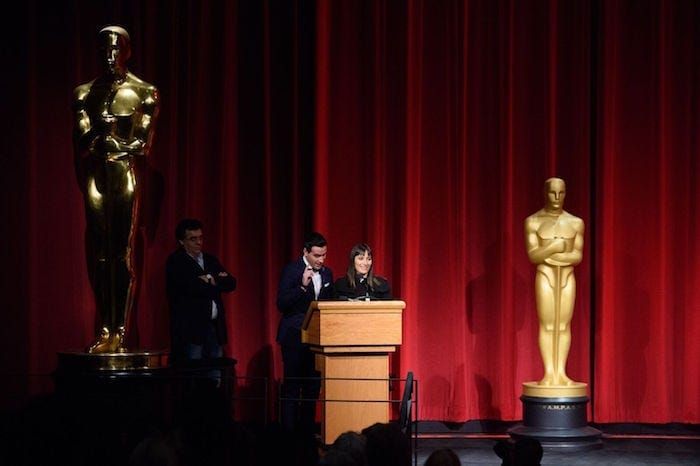
My conversation with the brother and sister writing duo from Australia.
Spencer and Lloyd Harvey wrote the original screenplay “Photo Booth” which won a 2016 Nicholl Fellowship in Screenwriting. Recently I had the opportunity to chat with the pair about their background as writers and filmmaker, and their award-winning screenplay.
Today in Part 6, Spencer and Lloyd share some insights into the writing craft and advice to aspiring screenwriters:
Scott: I’d like to talk about your approach to scene description, because it’s quite entertaining, compelling to read, and flies against that screenwriting guru convention of these unfilmables. You do some commentary from time to time. It’s like the narrator almost dropping in and providing some insight as to the mood or the tone of the moment.
Does that feel pretty natural to you? Are you aware of being judicious about doing that? We’re not writing a novel. It is an externalized reality but you feel comfortable. You understand what I’m talking about, right?
Spencer: Yes.
Scott: Could you talk a little bit about that?
Spencer: We love that. [laughs] I don’t know if that’s just us, but we love it. I love reading that in other people’s work as well because that’s when it reminds me that I’m watching a movie. There is going to be another voice there. That is the voice of the filmmakers.
Lloyd: The actors, the musicians. All of these pieces.
Spencer: All of these other pieces and it reminds us that there’s a greater goal. There’s something more than just, “He picks up his hat and puts it down on the table.” There’s something more to it. There’s a greater purpose to any of those minor actions. I think sometimes hearing that filmmaker’s voice can assist the tone.
Lloyd: Throughout our drafting process, we do a lot of table reads with other writers and actor friends. That, for me, really helps to see when it needs more flavor, or less, or where to lean into the scene direction, to give weight to a scene or not.
Just because when you’re hearing it out loud and you’re watching people engage with it as a listener, that seems to help me see it.
Scott: That’s a really good note. I always tell people, “Just try it.” Then, people will read it and if it’s too much, you can pull it out.
Lloyd: You see that moment when people just start to disconnect because they’ve stopped listening. “OK, it’s too long now. We need to pull this back.” [laughs]
Scott: You think so cinematically. There’s a description, “Ben hangs back a minute. He looks small in such a large room,” which is a great way of framing what this guy’s life is like. Setups and payoffs, or callbacks, you got so many great ones in there.
You got a setup with an elephant. You got a thing with someone in a bathtub, water. I won’t get into it, but you’ve got so many of these wonderful setups and payoffs. How cognizant are you of that when you’re in the process of writing?
Spencer: Sometimes very much so, and other times, not at all. Actually, I remember, Michael Arndt, I don’t know if it was a podcast, or a speech, or something that I had read, but he’d spoken at a function and he was talking about the scene in Little Miss Sunshine, when the police pull the car over…
Scott: Little Miss Sunshine. Yeah.
Spencer: I feel like he described it best when he said, “The solution to his problem in how to get his characters out of the scene was inside the car,” as in, it had already been written. It was already in his movie somewhere. He didn’t need to reach outside of it.
Scott: Here’s what you have.
Spencer: Yeah, and I feel like that’s such a great way to explain what I want to say, which is, you get to a moment in your story and you look back. Sometimes you don’t even need to look back. Sometimes instinct just steps in and you know what you need to pull from. You know this is, a reprise of the “elephant” or a reprise of the “bathroom incident”.
Lloyd: The elephant being an interesting one, because I don’t think we had ever intended that to be as pivotal as it ended up becoming. We even found that it kind of back‑played a lot more than we expected too. It started out as a prop and quickly became a weighted vehicle throughout the rest of the draft.
Spencer: Kind of became a symbol for the whole thing. Pun intended.
Scott: The elephant in the room.
[laughter]
Spencer: Exactly!
[laughter]
Scott: Of course, that can happen too, the other way, where you’re writing along, all of a sudden, you hit on something great and you go, “Oh, wow! I can set that up, back 50 pages ago. That’ll be a great payoff here.”
Spencer: Yeah, that happens a little less often to us. I don’t know why. I wish that would happen more often.
Scott: A couple more questions. Perfect world, 10 years from now, what are you two doing?
Spencer: We hope to be making the films that we’re writing with love and support around us, with people that we enjoy collaborating with. That would just be…
Lloyd: That would definitely be the dream.
Spencer: …A dream come true.
Scott: Writing and directing?
Spencer: Yes.
Lloyd: Writing and directing, yes. We have a few other feature scripts we love that we’ve been redrafting and we continue to keep redrafting and we hope they…
Spencer: Become films after Photo Booth, if we’re lucky enough to…
Lloyd: …make “Photo Booth” which is the goal.
Scott: Let me end with this question. I’m sure you’ll start to be asked this much more as you move along in your career. What advice do you offer aspiring screenwriters about learning the craft and breaking into the business?
Spencer: I’m worried I’m going to give you some clichÈs.
[laughter]
Spencer: Ok, so I think, if you want to write, read a lot. Give yourself permission to make mistakes with people you trust, and make them often because that is the only way you learn.
Scott: Lloyd, you have anything to add?
Lloyd: If I was to add anything, and maybe this is kind of timely, I’d say give yourself permission to enjoy the small wins along the way.
Spencer: That’s a good one.
Lloyd: We make it a practice within our creating, our writing, and our making, that whenever we achieve a small thing…It could be just cracking a scene that was tough to crack, or it could be a really nice response from someone who’s read something of ours. Whatever it is, we make an effort to enjoy the win in that.
Scott: That’s actually really great advice because those victories, even the small ones, they’re sometimes hard to come by when you’re working in this business, so be sure to celebrate.
Lloyd: Yeah, and whatever a victory means to you, that’s all that needs to be.
Spencer: Yeah, exactly. Take yourself out for a margarita.
Scott: Have you seen that video with Kiwi Smith and Karen McCullah that they did for the Academy? Have you seen that video?
Spencer: Yes, we love them! Where they write by the pool and have margarita Fridays?
Scott: By the pool, right. [laughs]
Lloyd: They’re amazing. We think that is a very fantastic way to celebrate Friday. [laughs] Kirsten Smith was actually on this years Nicholl Committee…
Spencer: …that’s right she was. We’d love to have a margarita with those ladies one Friday.
For Part 1, go here.
Part 2, here.
Part 3, here.
Part 4, here.
Part 5, here.
Spencer and Lloyd are repped by UTA and The Gotham Group.
Twitter: @SpencerandLloyd.