Interview (Part 5): Jon Spaihts
A 6 part series featuring one of Hollywood’s most sought after screenwriters.
A 6 part series featuring one of Hollywood’s most sought after screenwriters.
I have been a fan of Jon Spaihts and his writing for years, so I was excited to have the opportunity recently to spend an hour talking with him about his career, his movies, and the screenwriting craft. His movie credits include Prometheus, Doctor Strange, and his latest Passengers, along with the upcoming films Van Helsing and The Mummy among many others.
Today in Part 5, Jon reflects on the 10 year odyssey of Passengers from script to screen and answers some craft questions:
Scott: I’m familiar with the script (Passengers) from an earlier iteration, but I absolutely love the ending you have in this most current draft. I hope that’s in the movie.
Jon: Yes, that is representative of the ending of the film. I think we found a beautiful way of finding redemption on two levels in one passage of story. To save not just Jim and Aurora, but everyone. To save not just lives but love.
Scott: Yeah, it’s a strong ending. I tried to put myself in your shoes when you hit on this idea, how satisfying that must have felt, like that’s the ending that was inbred in it, somehow waiting to be revealed.
Jon: I feel like it was. I’d always been looking for that act. When I found it and figured out how to do it, I felt the story blossom in my head and I knew that it was mature. I knew that it was complete.
Scott: Here you are, 10 years plus on this process. Ups and downs of pre‑productions and green lights that turn red. Now the movie’s about to come out, can you describe your emotions?
Jon: Oh, everything at once. It’s been a battle every step of the way. As recently as weeks ago I had my paddle in the water, pushing hard against creative changes that I thought were the wrong way to take the movie, just voting as hard as I can with the soft power of a screenwriter in favor of what I thought the best solutions were for the film.
Invariably, you win some arguments and you lose some arguments. Happily the movie turned out to be one I can stand behind. That’s a rare experience: to have been been so involved. To be on set every day, to be in post so much.
During production I actually played the role of every artificial intelligence. Every time one of the leads is talking to a robotic voice, on the day, that was me, talking through a microphone and a loudspeaker and standing beside the director so he could cue me. I got to play scenes with each of those extraordinary actors. It was an incredibly fortunate experience for a screenwriter to have. You can still here my voice in the film in places. There’s going to be a Thomas Newman film score that belongs to my story. It’ll be there for the rest of my life, and I’m still star‑struck about that.
But it’s already time to let go of it, because it’s done. Time to move forward. This thing that’s been a calling card for my entire writing career has gone from being my script to being somebody else’s film. It’s time to write the next calling card.
What I’m hoping to do is get more original stories told in this space. To tell original stories onscreen is why I came to Hollywood and is still the thing that keeps me here.
Scott: Let’s jump into some craft questions here, Jon. You mentioned you’ve got a whole set of original ideas, which raises the question, how do you come up with story ideas?
Jon: It’s a good question and part of the answer is I don’t know. I don’t know where ideas come from, but I do know that they have a way of taking root in response to investigation. Meaning that it’s actually not too hard to sit down and shake the tree, to try to write 10 good story ideas down on the front page of a legal pad over lunch one day, and come up with 10 ideas.
For me this is a phase of the work that is best done out loud. I’m always at my best if I can find somebody to talk to and riff with out loud, because there’s limits to what I can do on paper, or on a computer screen, or in the silence of my head.
There’s something magical that happens for me between the brain and the mouth. Sentences put themselves together. New ideas jump in from some mystical source.
There’s a reason, I think, that Passengers and Prometheus were both born in phone conversations when somebody asked me a provocative question. Part of what I try to do is prime the pump by finding ways to ask myself provocative questions in conversation with various people who are good sounding boards and conversational partners, and seeing what comes of it.
Once a story idea takes hold, usually it’s a few leaps short of maturity. It needs subsequent lightning bolts of inspiration to bring it home. Those will come at strange times. I’m often inspired by other stories — other movies, and TV shows, and books…especially, oddly enough, bad ones.
If I watch a terrible movie, my head is always out ahead of it trying to figure out where it’s going and what it’s trying to do, and it usually goes off in some other direction. It doesn’t try to do what I was thinking at all, but now I have a new idea. Sometimes I like my version much better and it grows into a new story.
I used to have that experience writing poetry, where I’d go hear bands play downtown and my head would be out ahead of the vocalist, imagining where the lyric was going. Then the lyric would go off in some unexpected direction, but I’d have these new words in my head that I was predicting, and they were mine. They’d become the seeds of new lyrics or new poems.
The same thing happens for me with a story all the time. I try to guess where things are going but then they don’t go there, and now I have something new.
Scott: I think you’re the first person I’ve interviewed that said, “I benefit from talking to people.” Most people will say, “Well, I don’t know. I’m in the shower,” or some people have real work habits. They literally say, “I’m going to come up with a story idea today,” or whatever, but I think stories are the oral tradition. The idea that you can be…
Jon: Talking out loud is utterly essential, and there’s two pieces to it. One is the instant reactivity. You’re a lousy audience for yourself, because you’re naturally going to like what you’re selling. But, the person across the table is a better judge of what’s compelling and what’s interesting.
We very naturally tune stories in reaction to miniscule cues and micro-expressions from our listeners. If a part of the story is starting to drag, they don’t need to tell us. We’ll see instantly in their faces and their bearing that it’s getting dull and we quicken the pace. If something captures their attention, we’ll see their pupils dilate and they’ll lean in and their mouth will open and their body language will shift, so you dig deeper into that idea and expand upon it.
In all those ways, telling your story to a few good listeners, people whose judgment you like, will coach you toward the best version of your story. You’re going to elide what’s dull. You’re going to dig deeper into what’s amazing. They’ll show you what is great about your idea.
There’s also something mysterious. Sometimes you’ll find in the telling that you’ve been glossing over something in an outline in your notebook, or in the sketch of the story you have in your head. When you get to the vague part as you’re telling it, you’ve got to fill it in, but you’re committed now. You’re talking out loud, so you can’t stop and take a minute. You just thrash through the vague part, conjuring up details as you go, like a kid who didn’t read the book giving a report in class. Often, great material comes out.
When those vague spots hit and you have to somehow negotiate them in real time, often story problems get solved, story problems that you didn’t know were there until you put yourself on the spot. I really can’t say enough in favor of working out an idea out loud.
Scott: We’ve now segued from generating story ideas into prep writing. This is part of your process when you’re developing a story?
Jon: Yeah, in the outlining phase. I hold story in my head pretty well. I get up to a high level of detail before I commit anything to paper. I just walk around telling myself the story all the time, and then sometimes telling it to a friend who will listen, or assailing my lovely wife, who is great with story, with the latest version of this thing. She’s a great collaborator. There’s ideas of hers in virtually everything I’ve written. She’s a wonderful partner. And the magic of talking helps me to complete the story. It’s much more than just road‑testing something I’ve already completed. It is the way I get to completeness.
Tomorrow in Part 6, Jon delves more deeply into craft questions and provides great advice for aspiring screenwriters.
For Part 1 of the interview, go here.
Part 2, here.
Part 3, here.
Part 4, here.
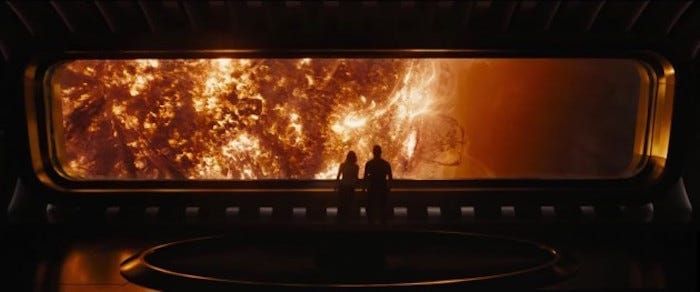
Passengers, which stars Jennifer Lawrence and Chris Pratt, opens this week in North America and theaters around the world.
Visit the movie’s website here.
For more background on the movie’s decade long odyssey from script to screen, check out this Hollywood Reporter article: ‘Passengers’: The Long, Strange Trip to the Big Screen. And this Indiewire article: ‘Passengers’: Why It Took a Decade to Launch a Black List Darling.
And this: The Science Of ‘Passengers’ According To Screenwriter Jon Spaihts.
Jon is repped by CAA and Circle of Confusion.
Twitter: @jonspaihts.